

Before Starting Math in College This lesson is a sample from The Ultimate Crash Course for PLEM Majors series. Get access to over 1,000 ad-free lessons covering mathematics, physics, engineering, textbook learning, scientific communication, and STEM career preparation. Fourthwall Store | Payhip Store Before You Start a Math Degree in […]
AuthorJonD
214 posts
Understanding The STEM Major’s Guide to the University
In this lesson, Jonathan David explains how the
STEM Major’s Guide to the University is organized inside P.L.E.M. Academy and how the
research position, certificate system, textbook development, and lesson library all work together.
The lesson explains that active problems first appear inside the research position where students can participate by reviewing lessons and leaving comments for publication credit in future books.
After the lessons are edited and refined, they are categorized into the appropriate textbook sections throughout the website.
Students are shown how the accordion system works, how lesson previews appear for non members, and how membership restricted material becomes available after logging in.
Jonathan also explains that the project is being built gradually over time and that the long term goal is to create a massive organized library of advanced STEM examples, textbook walkthroughs, and professional academic demonstrations for college students.
The lesson emphasizes that the goal is not simply to solve homework problems, but rather to teach students how to think and work professionally using real textbook style examples from mathematics, physics, engineering, and related STEM subjects.
“I'm not here to do your homework for you. I'm trying to show you guys how to be professional and how to use your textbook correctly by doing real examples that you guys see in college.”
— Jonathan David

Resume Building for STEM Majors This lesson is a sample from The Ultimate Crash Course for PLEM Majors series. Get access to over 1,000 ad-free lessons covering mathematics, physics, engineering, resume development, scientific communication, WordPress development, and STEM career preparation. Fourthwall Store | Payhip Store Why Most STEM Students Are […]
Understanding The STEM Major’s Guide to the University
In this lesson, Jonathan David explains how the
STEM Major’s Guide to the University is organized inside P.L.E.M. Academy and how the
research position, certificate system, textbook development, and lesson library all work together.
The lesson explains that active problems first appear inside the research position where students can participate by reviewing lessons and leaving comments for publication credit in future books.
After the lessons are edited and refined, they are categorized into the appropriate textbook sections throughout the website.
Students are shown how the accordion system works, how lesson previews appear for non members, and how membership restricted material becomes available after logging in.
Jonathan also explains that the project is being built gradually over time and that the long term goal is to create a massive organized library of advanced STEM examples, textbook walkthroughs, and professional academic demonstrations for college students.
The lesson emphasizes that the goal is not simply to solve homework problems, but rather to teach students how to think and work professionally using real textbook style examples from mathematics, physics, engineering, and related STEM subjects.
“I'm not here to do your homework for you. I'm trying to show you guys how to be professional and how to use your textbook correctly by doing real examples that you guys see in college.”
— Jonathan David
Textbook Question Submission Form Please provide your textbook information so your question can be reviewed properly. If you do not have a textbook, the question will not be addressed one way or another. Your Name Your Email Textbook Title Textbook Edition ISBN Question Number Additional Comments Maximum comment length: 150...
• [Precalculus] Wednesday 10:30 AM – 11:30 Am Central (CST) [Zoom Link]...

Scientific Communication via Electronic Means This lesson is a sample from The Ultimate Crash Course for PLEM Majors series. Get access to over 1,000 ad-free lessons covering mathematics, physics, engineering, WordPress development, scientific communication, and STEM career preparation. Fourthwall Store | Payhip Store Introduction to Scientific Communication via Electronic Means […]

Parametric Curves and Surfaces with MacBook Grapher This lesson is a sample from The Ultimate Crash Course for PLEM Majors series. Get access to over 1,000 ad-free lessons covering mathematics, physics, engineering, scientific communication, MacBook Grapher, and STEM career preparation. Fourthwall Store | Payhip Store How to Parameterize Curves and […]

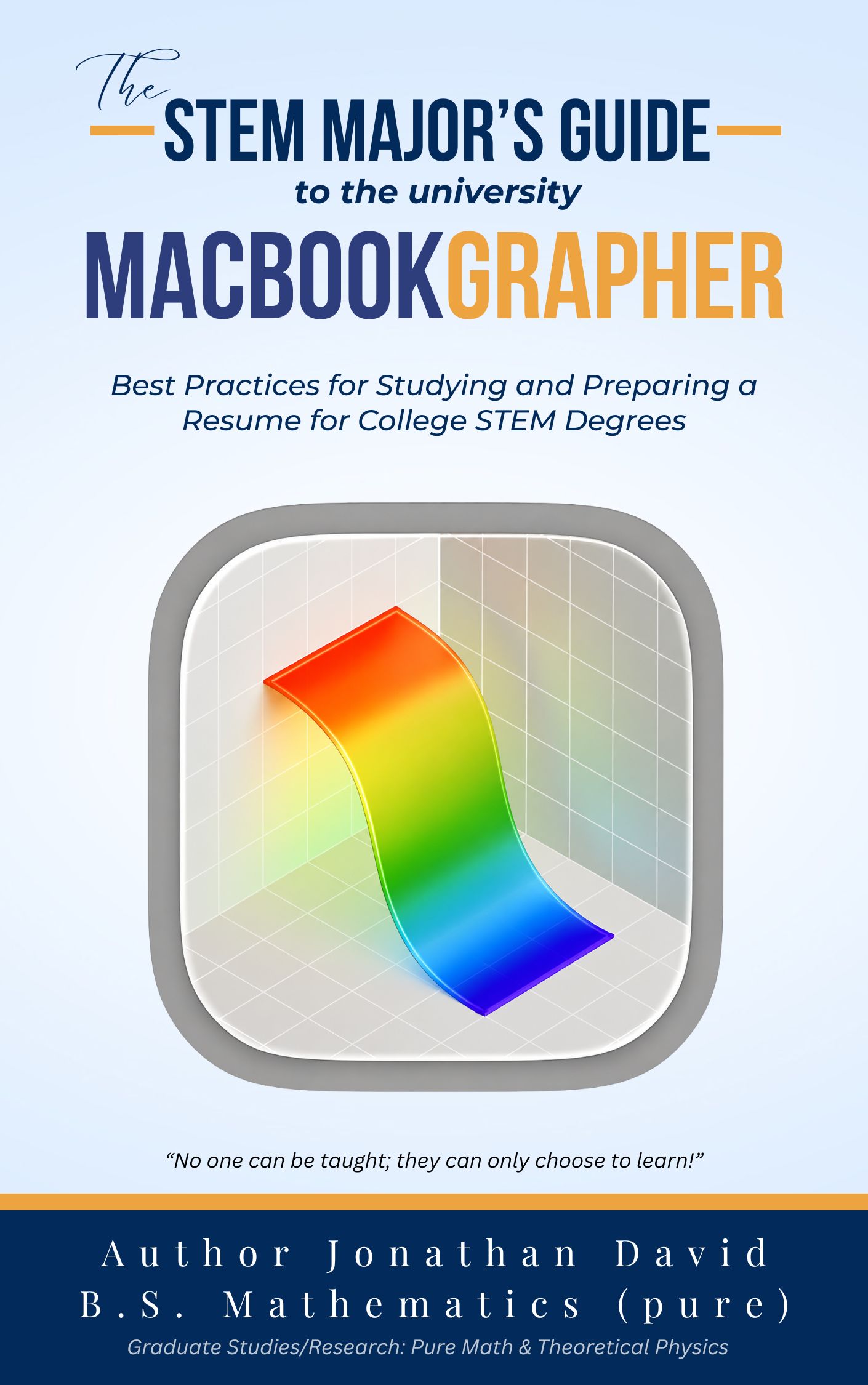
Understanding The STEM Major’s Guide to the University
In this lesson, Jonathan David explains how the
STEM Major’s Guide to the University is organized inside P.L.E.M. Academy and how the
research position, certificate system, textbook development, and lesson library all work together.
The lesson explains that active problems first appear inside the research position where students can participate by reviewing lessons and leaving comments for publication credit in future books.
After the lessons are edited and refined, they are categorized into the appropriate textbook sections throughout the website.
Students are shown how the accordion system works, how lesson previews appear for non members, and how membership restricted material becomes available after logging in.
Jonathan also explains that the project is being built gradually over time and that the long term goal is to create a massive organized library of advanced STEM examples, textbook walkthroughs, and professional academic demonstrations for college students.
The lesson emphasizes that the goal is not simply to solve homework problems, but rather to teach students how to think and work professionally using real textbook style examples from mathematics, physics, engineering, and related STEM subjects.
“I'm not here to do your homework for you. I'm trying to show you guys how to be professional and how to use your textbook correctly by doing real examples that you guys see in college.”
— Jonathan David
Microsoft Word Math Print vs LaTeX Typeset Software This lesson is a sample from The Ultimate Crash Course for PLEM Majors series. Get access to over 1,000 ad-free lessons covering mathematics, physics, engineering, scientific communication, WordPress development, and STEM career preparation. Fourthwall Store | Payhip Store How to Use Microsoft […]